Sunday, 7 July 2013

Shanghai in Cork


Yanyan Wong and Shihui Zhang are exchange students from the Shanghai University of Fine Art. They spent three months in spring practicing glass, ceramic and textiles at C.I.T Crawford College of Art and Design, Cork. After six weeks of dedicated work, the girls showcased some pieces in the recently renovated foyer area of the college. 

Everybody at the college was delighted to see an influx of new and interesting material, and also such a great volume of work after six weeks. The girls were so friendly and enthusiastic; they really made their mark on the students. Not only was their lunchtime showcase pleasing to the eye, there was a wonderful social element between the girls, the students and our tutor, Debbie Dawson. It was a pleasure to be present at what may be the first of many glass showcases in the college. The new Applied Art course is starting up next September, our little glass community in the college will hopefully blossom.


Yan’s work uses glass, ceramic and textile.  Her practice is about flowers floating on the River Lee. She discovered the idea when she was rowing on the River Lee on her first Saturday in Cork. A beautiful permutation occurred in this work where Yan was able to merge the primary materials of glass, ceramic and textiles. Combining these materials brings about a new understanding of these elements; weight, density, texture. The transparency and two dimensional qualities of the glass give way to the more solid and three dimensional qualities of the ceramic. A beginning; Yan certainly seems to be creating something exciting here. She is intuitive, a quality that I have heard students speaking of at the Shanghai Academy. However, this natural intuition is always accompanied by careful consideration of the process.      

Focusing on material properties, Yan has used hard and soft material together. She describes this piece as “a contradictory work”. It’s a delicate type of contradiction. The glass is etched and then, like a patchwork quilt she has very affectionately worked the fibers around each panel. This work is one that is much more poignant when seen in the flesh. Gorgeous meditative oranges and subtle hints from other palettes flow. The river is truly present here. The piece is a river itself and each panel is presented as moment from its surface. It is a mix between a traditional Chinese scroll, a patchwork quilt, and a stained glass panel. We can see a beautiful synthesis of antiquity, complemented by a subtle sense of inventiveness. 


Shihuis’ work is about shape. She states “The most simple shape of the world is round, square and triangle”. She uses the plane of shape and the plane of material to make three-dimensional effects. Her work, in contrast to Yan’s, is more design based. The very careful execution of this simple concept makes for an interesting consideration of form. One associates the work with the inner workings of the cosmos; shapes construct other shapes, which in turn construct other shapes and so on. This approach plays on micro and macro imagery. Exploring how we all exist in this world in a physical alliance. It speaks of symbiosis; it is organic yet can also place itself in the realms of something practical and mathematical. Shihui had worked on many ways of conveying this sense of shape. It is simplicity she admires the most. This has provided an excellent platform from which to continue her endeavors. I am excited to see her progression with the work once she has settled back in Shanghai.

The quality and quantity of the work after just six weeks was something that took our students by surprise. We have all heard of the Chinese work ethic, however the girls seemed to have this and also some another magic behind them. Their dedication to all materials under investigation is to their credit. They dealt with each element appropriately and appeared to have no discomfort in showcasing their works or experimenting. They are proud and genuinely interested in both the material and conceptual relationships between the maker, material and the other life that the work emanates after it is has been granted freedom in the artistic realm. The girls visit was something of an inspiration, they displayed a mystical sense of wonderment about them. They carry themselves with an honest, polite grace that can be seen through their work. It is this honesty and pursuit of the self that has certainly rubbed off on myself and a notable few that have been to Shanghai on exchange, but also those who shared our glass-workshop with them. I feel as though I have visited their culture, I have yet to discover in what way. 


Written by Róisín Foley, C.I.T CCAD Glass, R.E.P Glass Society of Ireland

Tuesday, 2 July 2013

Mud & Sand at Gallery Zozimus


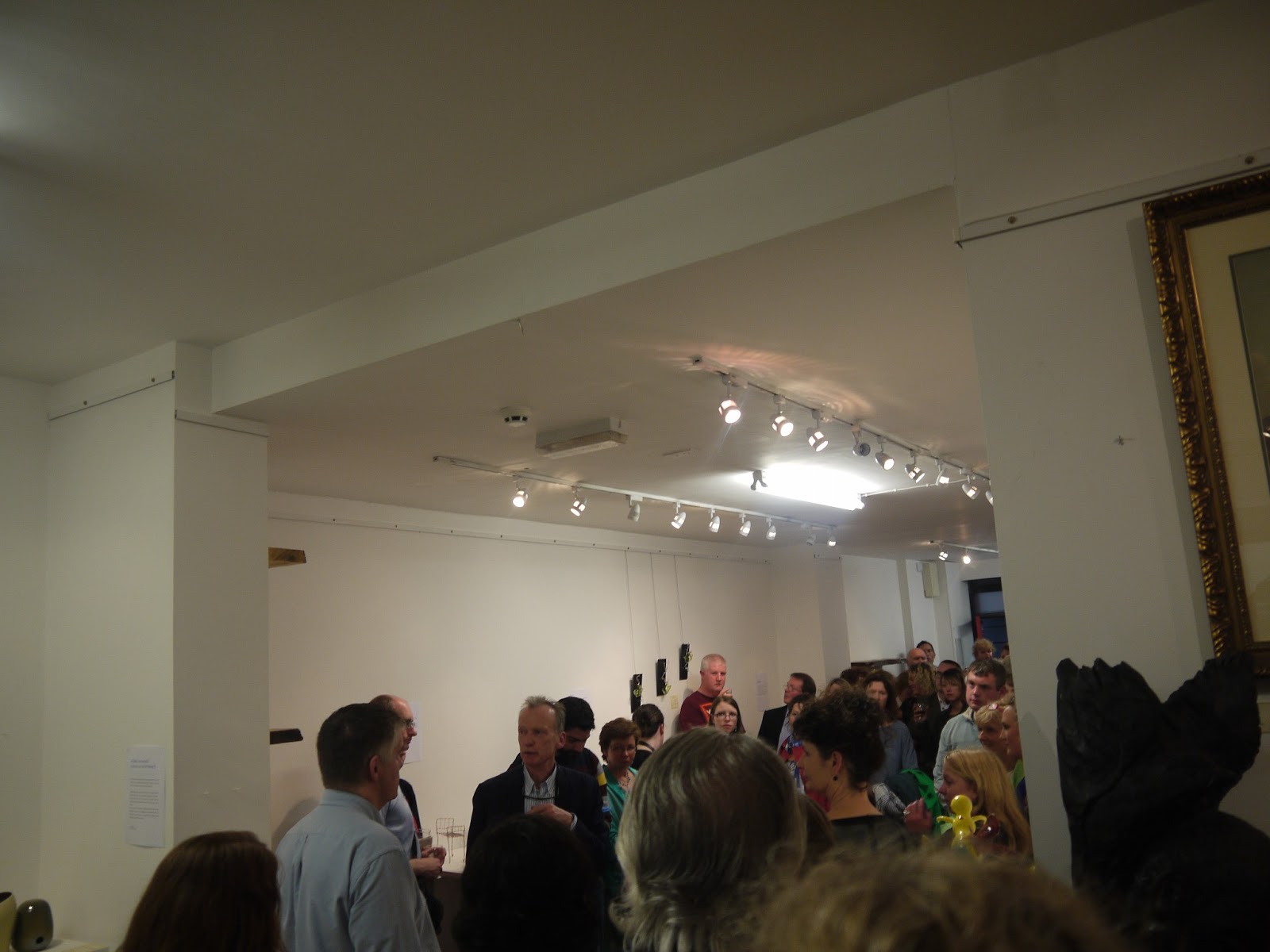
Third year Glass and Ceramic students in NCAD have been very busy these last few weeks, labouring on while the newly graduated 4th years finally relaxed All their hard work paid off however at the opening of Mud & Sand last Thursday at Gallery Zozimus on Francis St.

Zozimus represents over 120 artists and is Dublin's only ceramics gallery. Just around the corner from NCAD, the gallery has a strong relationship with the college and regularly exhibits work from ceramics undergraduates Their exhibitions have always been a great success for gallery and artists alike and this one was no different - opening night saw the gallery full to capacity and a lovely evening was enjoyed by all. 


The work on display is as diverse as the students who made it; from Kathy Burke's  carefully considered ceramic multiples to Etaoin O'Reily's playful and brightly coloured 'Buggaplants' the work displayed shows personality and craftsmanship. It is no surprise to see little red-stickers popping up all over the exhibition - these beautiful pieces, are very reasonably priced.  


The 3rd year glass students; Mags O'Dea, Gwyn Grace and Sadhbh Mowlds  stood their own amongst the larger number of ceramics students showing both blown and fused glass work.


 Mags O'Dea presented 'Transparent' which comprised of delicate pate de verre sculptures of hot-water bottles on wiry beds. Her work emphasises the limitations of social care in hospitals. It is worth noting that Mags worked as a theatre nurse before deciding to pursue art so no doubt the subject is close to home. 
The hot water bottle is a metaphor for the patient’s feelings of isolation and vulnerability, it's position on the unforgiving wire mattress highlighting the lack of homely comfort and security patients feel as they wait on trolleys.  


Gwyn  Grace  presented 'Boglands' a  collection of   sculptural vessels in patte de verre glass, the fragility of which depicts the delicate state of the Irish bog-lands; her forms and colours came from the tiny Sundew plant, a protected species, native to the bog. 

Pate de Verre is a technique of making glass forms out of crushed glass powder. While the technique allows for a great deal of detail with colour it is notoriously delicate.  
Gwyn has been involved with the Irish Peatland Conservation Council for a number of years and this project  was inspired by  her work with them. 


Last but not least Sadhbh Mowlds presented 'one man's trash...  is another woman's weird obsession'. These beautiful cane-worked glass plastic bags blowing in the imaginary wind are about the significance of a common object that is often overlooked and also about translating the ephemerality of billowing plastic into something solid and frozen. 


Sadhbh, Mags and Gwyn will all be showing work in the Botanic Gardens exhibition, Sculpture in Context in September. 
Well done to all the artists showing in Gallery Zozimus at present, the hard work shows. If you haven't seen it yet there's still time, the exhibition runs until July 7th!


Written by Meadhbh McIlgorm 


Sunday, 30 June 2013

NCAD end of show: Student Profiles

The final installment from NCAD's glass degree show 2013 and last but definitely not least Michelle Mc Dermott:


Michelle has a great interest in visual world around her, being particularly drawn to nature and organic forms. Her research takes her to many parks and gardens where she gathers this visual information, ready for manipulation in the studio. She says that ‘from a good image many ideas can flow’. Her interest in photography enables the production of these inspiring images.


The forms presented in the degree were a series of decorative panels developed from this study of organic objects. They have used multiple firing techniques and often encompass layers that give the flat panels a sense of dept. The shape used for the panels is a simple but effective leaf motif which provides a connection between their surface decoration and the form.


The result is a wall that looks like a magical plant climbing its way up to the light. The drawings are sensitive and the use of colour is minimal. The delicately of this approach creates an atmosphere which invites quite reflection.


I would like to take this opportunity on behalf of the Glass Society of Ireland to wish the new graduates all the best in future and we look forward to hearing about all your up and coming exhibitions – stay in touch!


written by Fiona Byrne

Tuesday, 25 June 2013

NCAD end of year show: Student Profiles

As promised talented graduate number two – Meadhbh McIlgorm


Meadhbh has recently been awarded the CCOI Future Makers Student Award and one of her pieces was selected for the RDS Craft Exhibition. Watch this space!


Meadhbh’s work is an installation made up of numerous ‘intangible’ objects. The delicate pieces are suspended within the space creating a refraction of light and casting thin shadows. These light and dark elements are as much a part of the work as the glass itself – they are the finishing touches.

In her own words Meadhbh is ‘attempting to capture both the tangible and intangible essence of cloud formations’. The beginning of this exploration was research into the manipulation of light. The changeable nature of light and the challenges involved in capturing some of its magic has been approached here with skill and consideration. The result is a piece of work which captures the fragility of glass. The wispy shapes look as if they would crumble if touched (although Meadhbh told me they were tougher than they looked!).


I asked a little about the process of making this work and Meadhbh explained how the forms are heated in a kiln, letting gravity act of the glass allowing an element of random formation. This seems an apt approach to the chaotic but beautiful objects which this process creates.


The pieces will be displayed in Sculpture in Context in September so if you missed this show stopper at the degree show you have been granted a second chance!


Written by Fiona Byrne

Thursday, 20 June 2013

Glass at NCAD end of year show

Hi all sorry for the lack of blog posts recently it has been a busy time for us all at the Glass Society. We will have a shiny new webpage soon and our wonderful student rep Meadhbh McIlgorm has taken over from myself as the Media and Communications Officer. But before I hand over completely I wanted to share the amazing talent in this year’s National College of Art and Design degree show which featured: Jesse Gunther, Meadhbh McIlgorm and Michelle Mc Dermott.

We will be presenting a blog feature on each of the above newly hatched glass artists.


First up is Jesse Gunther:

Jesse’s work is a stunning combination of glass and metal work. The hugely labour intensive process used to create the glass components has resulted in wonderfully crafted pieces that are finish to an incredibly high standard. His use of metal started in his Dad’s workshop before college but it did not inform his art work until the creation of a piece for Sculpture in Context at the Botanical Gardens last year.


The appearance of his work seems futuristic and almost otherworldly. When I questioned him on this he said that all the forms for the pieces actually found their routes in nature. His artist’s statement describes how this series of biomorphic, hybrid sculptural forms represent an aesthetic exploration of a variety of natural organisms. He borrows features from insects such as dragonflies and invertebrates such as squid.


If you want to see these beautiful creations in the flesh the show is open until the 22 of June so there is still some time!


Written by Fiona Byrne

Wednesday, 19 June 2013

Glass Society of Ireland - Mission Statement

The Glass Society of Ireland is made up of people whose interests or professions significantly relate to the specific material of glass.  Drawing from diverse creative and enterprising fields including art, design, craft, research, collecting and the historical context, we are a volunteer-run organisation whose interest in glass provides us with a mutual cause for conversation.

 It is the primary objective of the Glass Society of Ireland to continue to support established practitioners in Glass whilst fostering new talent. We also aim to create opportunities to communicate with each other and to engage with new audiences. This is achieved through a number of platforms: exhibition-making, holding events such as conferences, workshops and public talks, networking through social media and information distribution through our website, blog and monthly e-bulletin. Through these activities, professional connections are established both nationally and internationally.

Friday, 3 May 2013

Boyd Sugiki & Lisa Zerkowitz: Lectures on personal practice

Apologies for the slow down on blog post in the last few weeks, I have been away in Scotland but am returning soon and will get lots of news and articles up ASAP! In the mean time you may like to get your glass fix at this talk at the National College of Art and Design:


Tuesday, 12 March 2013

Glassblowing in Stourbridge


The following article has been written by GSoI member Catherine Keenan. Catherine Keenan is a glass artist based on the lovely north coast of Ireland, in Portstewart.

Finding a glassblowing studio whose hiring rates are reasonably priced, with a skilled assistant on hand, if desired, and the studio is always up and running and available has proven difficult to find over the years.  Since 2009 I had travelled to Sunderland to hire at the National Glass Centre, but with their major renovations last summer I was forced to find a new venue.  So I took a chance on the ‘Stourbridge Glassblowing Studio’, at the Ruskin Glass Centre.  It is part run by my ‘old’ teacher from the International Glass Centre, Stephen Foster who shares it with Peter Fricker and brothers Ian and Vic Bamforth.


A major draw for me to hire their studio is the fact that Ian Bamforth assists me, therefore he knows all the workings of the space and as a skilled maker can offer helpful advice.  He’s also easy going and a good laugh...that always helps when under pressure due to the expense and time restraints of hiring!

Although you will need to bring your own hand tools, with a some prior communication, the studio has everything else you would need.  I would suggest to other irish makers who are flying over to order your glass colour so it is delivered directly to the studio. 

There is an introductory offer for your first day of hiring; £135 and subsequent days are 
£170 each.  It’s £80 per day for an assistant.


If you can spare some time to see the area there are several museums and quite a few studios to visit.  The Ruskin Glass Centre, which hosts the British Glass Festival and Biennale, has many glass artists based there and also the recently opened Webb Corbett Visitor Centre.  I was fortunate enough to be personally shown around the museum by former factory master glassblower Malcolm Andrews.  He also happened to teach at the International Glass Centre, Brierley Hill (before my time) and had very fond memories of a young Paedar Lamb!


Not far up the road (it’s called the ‘Crystal Mile’) is the Red House Glass Cone, which is the only fully intact example of the18th century red brick glass cones that used to be dotted all over the area.  There’s a museum display and glassblowing studio with live demos.  Then, just a bit further still, is Broadfield House Glass Museum which has a huge glass collection ranging from the 17th century to the present day.  You can also watch skilled glassblower Allister Malcolm at work.

If you like real ale I can’t imagine there’s a better place in England to sample a wide variety of great beer in real pubs...that’s another reason to enlist Ian as an assistant as he’s a wealth of knowledge on decent pubs!

It’s easy enough to get to Stourbridge from Birmingham airport, there is a train station at the terminal (connected by a monorail), you get the train to Birmingham New Street, then walk to Moore Street Station (5 mins) and get the train to Stourbridge Junction, and finally get a connecting train to Stourbridge Town.  You can get a taxi from there, or ask at the bus station for a stop by the Ruby Cantonese Chinese Restaurant which is beside the Ruskin Glass Centre.

If you have any questions feel free to contact me via email: catherinekeenan126@gmail.com


by Catherine Kennan


Friday, 8 March 2013

Karen Donnellan writes about Jeff Zimmer for GAS Newsletter


Jeff Zimmer’s background in acting retains a strong influence over his work. The series, Theatres of Glass (2010-2011) is an obvious offshoot, but even the newest works from the whitewash series feel like a scene, set for action. After completing a Bachelor of Arts in Theatre Studies, Zimmer realised the vulnerability inherent in acting in the rehearsal stage was too much for a lifetime’s pursuit. Conversely, creating an object separate from the artist allowed him to experiment with creative abandon in the privacy of his own studio. Thus began his career as a visual artist and maker.

The artist’s current series, whitewash, is decidedly political in content. In each of these beautiful snow-scapes, the debris and reminders of death are only partially hidden from view. It is an anti-war statement, but is made in a way that “those who supported the war can look at it and appreciate it.” Jeff employs a Taoist approach in the assertions he makes
within the work. Being very conscious of the growing polarization of politics and society in the US, his work is an empathetic communication of his ideals. While consciously making them as beautiful as possible, it allows for the ugly message to be put across in a more digestible way. In doing so, he hopes for the audience to appreciate the duality without judgment. In his own words, the work alludes to “the way in which we all try to whitewash something of ourselves, as individuals and as nations. It’s a human need to see oneself as someone who is good on some fundamental level, so that tension between the desire to present ourselves as good, is in conflict with the knowledge we have of the bad things we have done.” 


The key moment that redirected his creative energies towards painting in particular, came to pass at an exhibition of cubist art at the Montreal Museum of Fine Arts. Jeff describes this as “an incredible damascene moment where I suddenly started to see the world rendered in flat planes of three-dimensional stained glass. It was unlike anything I had seen in my life, but I knew then that I was going to work with flat glass.” Following several years of researching and solitary experimentation on the kitchen table with a 7” square kiln, Jeff came across a work by Judith Schaechter called Little Torcher at Renwick Gallery in DC. This pivotal discovery brought about some drastic technical and visual changes in Zimmer’s work and Schaechter later became a mentor.
 He also recognizes Tim Tate and Michael Janis of the Washington Glass School among those who inspired and supported him early on in his glass career. “Tim Tate was there at the beginning, being able to share a studio with him as he set up the Washington glass school opened so many doors, and the fact that he was so interested in taking glass and pushing it forward in terms of content was significant,” Zimmer says.
In 2004, Zimmer began working towards a Master’s to allow for a more focused and full-time exploration of the technique. His research of programs on both sides of the Atlantic lead him to the Edinburgh College of Art (now part of the University of Edinburgh). The program, then lead by Ray Flavell and Alec Galloway, was one of few that offered Architectural glass on a full time basis. It was here that his ideas on perception and ambiguity developed, which remain strong themes in his work to date. Upon graduation, he was offered a position as Artist in Residence, in addition to teaching architectural and stained glass to part-time students in conjunction with the college’s Office of Lifelong Learning Program. Jeff still runs the part-time stained glass course and is presently a Temporary Lecturer in Glass within the main Glass Department.

A residency at North Lands Creative
Glass in 2006 brought about another shift in artistic direction for Jeff. Having arrived in this remote landscape at the Northern tip of Scotland with a very cerebral proposal for new work, it proved difficult to resolve. However, he couldn’t help but respond to the 360-degree horizon he found there, which his first landscapes. The impetus of the series was in part, “to capture that elemental feeling of such vast space.” Previous to that opportunity, Jeff’s work had been strongly figurative, but as I found out, his military father painted landscapes as a hobby. Jeff’s work does stem from a very different emotional place, but even so, perhaps it is no surprise that he has been drawn to the genre.

Despite these references and the suggestive title, we were All wrong, the work retains an element of ambiguity. As for the frames, those are scoured from second-hand shops and auctions. The more ostentatious and grandiose, the better. As a classic marker of important and perhaps conservative art, Jeff conciously utilizes them to undermine the cosy nature that the patina of time gives to older art, implying a feeling of safety.
The notions of borders will be explored in Jeff’s next body of work, which is particularly relevant as the Scottish Independence Referendum is coming up in 2014. Where, as the artist notes, “We will have the whole country deciding how we define ourselves... Who is in? Who is out?”

Jeff is the editor of the Scottish Glass Society newsletter, which is published on
a quarterly basis. His work is represented by The wexler Gallery in Philadelphia and Maurine Littleton Gallery in washington, DC 
a quarterly basis. 


Jeff Zimmer will be teaching a glass painting workshop at the National Sculpture Factory this April, for more info see the NSF website: HERE 


This article was first published in GAS News, January 2013

The GSoI would like to thank  the GAS for allowing the reproduction of the above article for our blog
By Karen Donnellan


Sunday, 10 February 2013

Jeremy Lepisto at the National College of Art and Design


The Glass Society of Ireland was delighted to attend Jeremy Lepisto’s talk at the National College of Art and Design on Tuesday. He is very open about his work both conceptually and technically which made for a fascinating talk.


Lepisto grew up in the glass capital of America, Toledo, Ohio. This industrial setting has made a huge impact on his aesthetic. Looking at his body of work you can see hard architectural lines as well as iconic structure such as his water towers. These visual influences are only one part of the narrative which resonates from his childhood into his present day life.

The work ethic in the family was strong and Lepisto himself worked from an early age. He spoke fondly of his family and specially his Grandfather ‘Pops’. Lepisto tells of how his Grandfather took great pride in his work and believed “a firm foundation is the key to a successful structure”. This sentiment has left its mark and this can be seen not only in the care and quality of the art works Lepisto produces, but also in the images he showed of his immaculate workspaces.

Lepisto describes his work as self portraits, each one reflecting his current situation and how it relates to his present environment. In doing this he creates a body of work which encompasses both the banality and the complexity of life simultaneously.
This work, inspired by a sense of place and strong relationship with the visual experiences available in the United States, came up against a challenge when Lepisto and his wife made the decision to move to Australia. Away from his support network and the landscapes which appear as such an integral part of his early work Lepisto had to tackle his art from new angles.


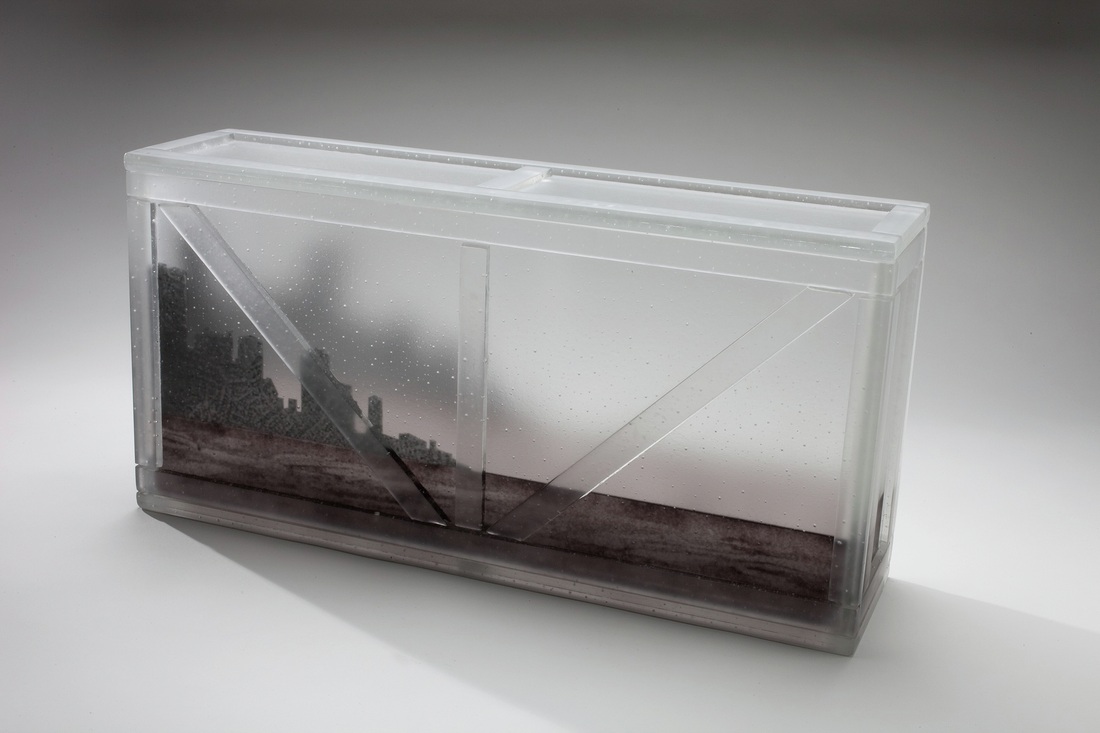
The most recent series, the container series, looks at transition and how life in one location can be packaged and moved another location. The lack of imagery in this series stems from a concern about appropriation of Australian vernacular architecture. This landscape, not yet ingrained in Lepisto sense of self, perhaps in time will begin to creep into new work. The auto biographical element in the work is strong and Lepisto is very open about the events which inspired the works.


 In an earlier series building blocks the pieces can be moved to form double meanings. In one position the images build from the edges into a cityscape, arranged in their second configuration to buildings start at the edges of the work and fade into a blank space in the centre. Lepisto explained how this series was made in a period where he and his wife where living in different locations. He drew our attention to the position of two small post boxes in the imagery and the piece changed from a clever puzzle to an eloquent expression of the pain of being apart and the joys of being reunited.

Lepisto’s practice is visually very beautiful and would be pleasing as studies of environment alone. However, it is the ability to produce subtle meanings in the works which push them to a new level of significance.


For More Info on Jeremy's work click HERE


by Fiona Byrne