Showing posts with label Artist Talks. Show all posts

Tuesday, 24 June 2014

Ulysses Cylinders Public Lecture

by Fiona Byrne


In the lead up to the opening of the Ulysses Cylinders exhibition by Dale Chilhuly and Seaver Leslie with Flora C. Mace and Joey Kirkpatrick a lecture was held at Dublin Castle. This lecture looked at the making of the exhibition, glass in Ulysses and also gave an insight into why the artists and organisers decided, almost forty years after the exhibition’s original conception, to recreate this iconic show.
The evening began with introductions from Paula Stokes and Róisín de Buitléar, who have both been instrumental in getting this exhibition to Ireland for its very fitting launch to coincide with the Bloomsday festivities. A screening of the making process of these beautiful pieces took place and the complexities of the artistic process were clear. These pieces have been lavished in gold, had delicate and intricate glass drawings melted into their surface, and then skilfully blown to their final shape. This labour intensive process encapsulates the love and effort on the part of everyone on this project to make the vision of the Ulysses Cylinders a reality.

The passion for the project is infectious. Seaver Leslie gave a wonderful talk about his role in the project and his respect for his fellow artists, including Joyce himself, is worn on his sleeve. His modesty is such that he comes across as a man who is proud to have been allowed to be part of this project and not as one of its main characters. However, once he began to speak you can feel the connection and depth of knowledge that he has for his subject matter.

He stressed the links with Ulysses and Joyce that go beyond a mere visual representation of the book. ‘Proportion is everything in the making of art’, Leslie tells us, echoing the harmonics of proportion in Ulysses. The joy of discovery also links these two artists we learn as Leslie recounts the story of finding a description of glass blowing in Ulysses and describes the emotion and pride he felt at his discovery. This is something which translates to the objects in the exhibition, as Róisín de Buitléar pointed out, you have to walk around each piece to get the full picture, you have to actively seek it.

Relationships are important in this project and ownership is not seen as an issue. Leslie expresses how all art steals and borrows inspiration from others. This exhibition is about collaboration and creation, using the ideas and talents of a group to push the art form to new levels. His collaboration with Chihuly began a long time ago when Leslie first encountered Chihuly working the hot work shop in college. He described how Chihuly’s vibrancy attracted an entourage of fun, creative people.

The contrast between the more singular process of a painter and this very team orientated process of glass blowing served to draw Leslie in to the world of Chihuly. He describes himself as being hidden in a forest and Chihuly being out there causing a storm. I for one am glad he chose to come out of his metaphorical hiding place and add his talents to the Ulysses Cylinders project.
Soul is the word which occurred again and again, finding something deep and essential within art, taking it, and making it your own. Leslie leaves us with the thought that Ulysses is a spiritual book and not to be daunted as, ‘you will find what you need’ from it.


After Leslie has spoken Dr. Luke Gibbons takes us ‘Through the glass darkly’ in his talk about the importance of glass in Joyce’s writing. He tells us that Joyce asked us to look at the glass and not just through the glass. To illustrate this he described the first scene of the Dubliners where there is a young boy looking up at the stained glass windows in a church.

Joyce used glass as a carrier of meaning in various ways, once saying that ‘only a transparent sheet separates me from madness’. Gibbons informs us of the fortuitous meeting of Joyce with Thomas Pugh of Pugh’s glass manufacturers. In Pugh he found a man who had claimed Ulysses as a seminal work but who operated outside of the academic circles, this, Gibbons tells us, was Joyce’s intended audience.
Though if seems artistic collaborations can sometimes go awry. Gibbons tells us of the mix up with a commission involving the artist Matisse who was asked to illustrate Ulysses. However misunderstanding the commission he illustrated Homer's Odyssey instead, leaving Ulysses without illustrations.

This project has had its set back also. Thirty nine years ago a tragic car accident stopped the original exhibition in its tracks and resulted in Chihuly losing the sight of his left eye.  Today the Ulysses Cylinders exhibition is on display at Dublin Castle after a long time in the making. This beautiful collection of objects holds more stories than those illustrated on their surface. They are alive with narratives waiting to be unlocked by the viewer.


Monday, 9 June 2014

GSoI Dublin Events 17th of June _ #chihulysses

To celebrate the arrival of Dale Chihuly in Dublin, the GSoI is hosting a number of events in the city on June 17th to coincide with his lecture and exhibition of the ‘Ulysses Cylinders’ at Dublin Castle. 
We hope that our satellite events will encourage even more of you to come and make a day of this event. Follow #chihulysses on facebook and twitter to keep up with events as they happen. 

After the lecture at Dublin Castle we will also be hosting an informal get-together with drinks, food and a small glass display for anyone interested at Bagots Hutton Bar (28 South William Street, 15min walk away from Dublin Castle) which will be a lovely chance to catch up with old friends and maybe make some new ones. 

 Here’s what will be happening on the day:


Historical Glass at the National Museum of Decorative Arts

Debbie Dawson will lead a group around the Visible Storage section of Collins’ Barracks. Debbie will look at the historical collection which consists of Irish, American and European glass dating from the 18th to the 20th Century. Traditional collecting centered on the industrial manufacture of Belfast, Cork, Dublin and Waterford in the late 18th to mid 19th Century. Debbie will also discuss the important collection of high quality Irish/Irish-related contemporary works that were purchased in association with the Crafts Council of Ireland.


The stained glass windows of St. Teresa’s Church
Peadar Lamb will give a talk on the series of stained glass windows in St. Teresa’s Church on Clarendon Street, Dublin. The stained glass windows date back to the 1960’s; some of which were executed by the Abbey Stained Glass Studio. In 1989 a series of windows for the nave were commissioned and executed by Irish artist Phyllis Burke. The windows depict scenes ranging from of the Resurrection to portrayals of various saints.


The Blaschka Collection at the Museum of Natural History

Emma Bourke will lead a tour of the Blaschka glass models of sea creatures in the Museum of Natural History. This unique collection of Blaschka glass is one of the largest in the world and is still displayed in its original 19th century cabinets Researcher of Blaschka glass and trained as a scientific lampworker, Emma has an intuitive understanding of this work. At 3pm she will lead a group up to the restricted third floor balcony, where she will explain the importance of these pieces to our national collection, the creation of the work and the restoration of the exhibits. Spaces are limited on this tour so registration is essential to be
guaranteed a space, contact emma.glasssocietyofireland@gmail.com to reserve a space. 

Wednesday, 23 April 2014

Glass Art Society Conference Chicago 2014


Richard Royal Demo
Coming from NCAD’s glass programme in Dublin, I was excited about the opportunities that going on student exchange at Southern Illinois University would bring. One of these opportunities was to attend the annual Glass Art Society Conference, held this year in Chicago. The conference ran from March 19-22 and was hosted across a few venues in Chicago. The lectures took place in the Palmer House Hotel near Chicago’s busiest area, the Loop. Demonstrations from artists took place in Ignite Glass Studios and West Supply Glass Studio. I had the fortune to stay at the Palmer House with the students from Southern Illinois University; I already knew this would be the nicest hotel I would stay in for a long time! Day one began with a welcome note, Lifetime Achievement Lecture and the Keynote Address in the Grand Ballroom of the Palmer House. What a beautiful surrounding for some great talks! Demonstrations were held during the latter part of the day in West Supply and Ignite Glass Studios. Marc Petrovic demonstrated his iconic birds in West Supply while Richard Royal tested the capacity of the glory holes in Ignite with a massive glass ball.  The opening reception was held in the Grand Ballroom later that night, with delicious signature food and punch from the Palmer House served on silver platters, no expense was spared!


Karren's lecture 
It was an early start for the second day of the Glass Art Society Conference in Chicago. The Emerging Artists talks are often one of the most popular lectures at the conference and this year was no exception, the room was filled with early birds. Jiyong Lee, currently on the Board of Directors for the Glass Art Society, and head of the Glass programme at Southern Illinois University introduced the three speakers; Steven Ciezki, Charlotte Potter and our very own Karen Donnellan. Karen, the only Irish speaker at the conference, received her Bachelor of Design from the National College of Art and Design (NCAD) in Glass, her Master of Arts from Rochester Institute of Technology (RIT) in New York State and is currently aArtist in Residence at NCAD. Karen begins her presentation with “Dia daoibh”, a friendly Irish phrase for my Irish ears.  She apologises for the early start as there were a few tired heads from the opening reception held the night before, but nevertheless looking bright-eyed herself. She explains that she is a qualified Reiki practitioner. The influence this has in her work becomes apparent as the lecture continues.  When Karen was an undergrad, she also participated in a student exchange at Southern Illinois University.  She discusses the work she developed there based on Chakras and shapes associated with feelings of being grounded and low centres of gravity.  Karen admits that colour for her was a language she used freely at an undergraduate level, but whilst studying in RIT she challenged herself not to use colour and thus found a new language in texture and form.  This language can very much be seen in the work that follows.  Her work has a meditative quality. Donnellan discussed how she signified this in her work 21 Days: this being the required timeframe to complete the healing process in Reiki cleansing.

Karen Donnellan 21 Days

Quite refreshingly, Donnellan shows a video of some glass-making processes, the audio of ringing solfeggio tuning forks filled the room, uninterrupted by any audience member. Again her focus on meditation can be recognised in this piece. Much of her lecture consists of talking about her time spent in an Emerging Artist Residency in Pilchuck Glass School in Seattle. She talks about the collaborative work she created with John Hogan. This work is more recent and explores the light and optics of glass.  Recently she has been invited to have a solo exhibition at the National Craft Gallery in Kilkenny. She talks about her interest in sound and the grant she recently received from the County Council to employ a sound technician. 

Donnellan mentioned other achievements but unfortunately one could only write so fast. She is an emerging artist with huge potential and is beginning to be recognised on the world glass art stage. Her pathway from undergrad on exchange at SIU to Emerging Artist at the GAS conference is a colourful, busy and a successful example for Irish glass artists.
After Karen’s lecture, I headed to the demonstrations later that day. I got the chance to see two marvellous demonstrations in Ignite and luckily for me I had a good vantage point of both lampworking and blowing studios. Chris Carlson demonstrated marble making with colour chip pick-ups and Martin Janecky also tested how large a piece could fit in the glory holes with a huge bull head.  Both demonstrations were heavily attended.

Chris Carlson making marbles 

Martin Janecky making a giant bulls head

At 5 o clock the Gallery Hop kicked off. Unfortunately I was not able to participate but the feedback was excellent. The hop featured many of Chicago’s exciting galleries such as the Made Gallery. The last day of the conference had an early start with demos beginning at 8am. I attended Kiva Ford’s lampworking demonstration in West Supply where he maticulously created a bottle within a bottle using blown borocilicate tubing.


Kiva Ford Flameworking demo


The Student Exhibition was open to the public later that evening and I took the opportunity to present my work in this show. Another highlight of the evening was the Neon Exhibiton also held in the Palmer House. Other services were available on the last day including the portfolio review open to all students, where one had the opportunity to have their body of work reviewed by a panel containing some of the Board and the demonstrators from the conference. The closing night party was held in Chicago’s Culture Centre and no better place to gather all these glass fanatics together than under its famous Tiffany glass dome.

The conference took place over three days and the schedule was jam-packed with demonstrations, lectures and several educational resources.  The Glass Art Society offers a discounted conference ticket price to members so it is definitely worthwhile becoming a GAS member. It also allows you to apply for scholarships to attend their conferences.  It was announced this week that the GAS Conference 2015 will be held in San José, hopefully there will be more Irish glass artists out in full colour there!
Myself, Karen Donnellan and Jennifer Mulligan, all GSoI members at the Closing Party


Written by Laura Quinn, GSoI Student Rep Dublin 

Tuesday, 17 December 2013

GSoI: Looking back on Orientate (Part 2)


Mmmmmmmm... So lunch was delicious, all were in agreement on that point. The cosy atmosphere of the canteen also provided a good opportunity for guests, speakers and board members alike to relax and discuss the conference so far. We felt that this was a very important element to include in the day. Opportunities for the Irish glass community to mingle are rare enough and we wanted to ensure the day left some room for everyone to re-connect and make some new connections.

Lunch finished and food digesting nicely we made our way back to the lecture hall. While the first half of the conference featured talks from speakers whose professional careers had been led by glass/craft but did not work with the material directly, the latter half was devoted to artists working with glass specifically.

Angela Thwaites 

First up was the wonderful Angela Thwaites. Angela is a glass artist, researcher and teacher based in London. She works predominately in kiln-cast glass and has been involved extensively in numerous research projects on refractory mould making for glass.  She talked about her practice and the development of her career which began with an undergraduate degree in glass and ceramics from Farnham College of Art and Design, Surry. A monumental point in her career occurred in 1983 when she was awarded a scholarship to study under one of the all-time masters of glass casting; Professor Libensky. After receiving three more consecutive scholarships, she completed her MA at the Academy of Applied Arts in Prague in 1985. 

Angela pointed out that the meaning of orientate is ‘to determine one’s position with reference to another point’.  She described her extensive career as a journey where, “each experience leads to another.” Her study period under the Czech master was a pivotal point in her practice. After it she was part of a research project at the Royal College of Art and in 2010 she was commissioned to write a book Mould Making for Glass which followed on from the findings of the project. She reminded us that any small opportunity such as a conversation at a conference perhaps or an exhibition call, could lead to the next important step in our careers. She also stressed that an open mind and willingness to never stop learning are paramount to progression.

The other area of Angela’s career which she feels has really brought her many valuable experiences is teaching. Angela is currently senior lecturer in Design Crafts at De Montfort University, Leicester and a tutor at Richmond Adult and Community College. In addition, she has taught at numerous institutions as a visiting lecturer and continues to teach workshops and master-classes in glass casting internationally. She finds teaching very rewarding and feels she often learns as much from students as they learn from her. We were delighted to have Angela teach a casting workshop in NCAD just prior to the symposium. She truly is a passionate and engaging educator. All the workshop participants enjoyed her warm, relaxed manner and genuine enthusiasm towards their casting projects. In addition to her teaching duties Angela works from her own studio which is slowly taking over her back garden. She is currently working on several projects, assisted by her cat!

Our second practitioner talk was from Slovenian artist and designer Tanja Pak(pronounced Tanya). Tanja is currently head of the glass and ceramics programme at the Academy of Fine Art and Design in Ljubljana, Slovenia’s capital. Tanja’s talk was entitled ‘Immersed in Duality’ and she focused on her relationship with glass as both an artist and a designer.

Tanja Pak
Her work is influenced by the rhythm and flow of the natural world. She works from a restrained colour pallet; black, white and transparent glass, so nothing distracts from the organic simplicity of her forms. Tanja began her career as an industrial designer, graduating in 1994 from the Academy of Fine Arts and Design in Ljubljana. This initial training in design is evident in how her complex ideas are simplified and expressed as functional glassware which is manufactured in collaboration with Slovenian glass factories. The glass tableware is functional and stylish and has received honourable mentions in the Red Dot Design Awards. While it is very commercially successful, evidence of the artist’s passions and influences still remain. The design of the vessels echo water drops and ripples. Graceful curves and soft lines give these manufactured pieces a very organic and feminine feel. Tanja does not see a difference, as such, between her practice as a designer and as an artist. The same inspirations create both lines of work; they are two sides of the same coin and walking the line between them is an exciting challenge for her.

There is a meditative quality to all her work – quiet and still, a frozen moment. It is most evident in her large installations which are often immersive environments incorporating smells and sounds as well as lighting and visuals. An example of one such installation was Within at Ljubljana Castle, 2010. This work featured cast glass branches, illuminated within wooden ‘trees’. The room was darkened and visitors’ footsteps muted by the chipped bark across the floor. The bark also filled the room with an earthy smell, further enhancing the illusion of being in meditative woodland. The atmosphere Tanja creates in her installations is one of tranquillity and reflection. She uses glass for its special relationship with light which becomes part of the complete experience of the work. “Glass for me”, she said, “is pure poetry”. Her talk showed numerous slides and videos of her installation but I imagine they cannot compete with seeing the work in person – I hope I get the chance to do so one day.

Cappy Thompson 
Wrapping up a very successful and informative day was CappyThompson who came all the way from her native Seattle, Washington, USA. Cappy is regarded as one of the world’s best glass painters, a master of the grisaille or gray-tonal painting technique. However, the material glass or the technique she uses is not of central importance to her. Cappy is first and foremost a painter and what is important is the narrative content of the work rather than its canvas. She is self-taught in glass working, beginning as a stained glass painter. Her initial paintings were influenced by folk art and mythology. While the design of her imagery still references this style of drawing the content developed to become entirely her own and is drawn from her personal life experiences and dreams.

Cappy’s lecture dealt with her beginnings as an artist and then traced the development of her style and career through the content of her work. The audience, at least many that I spoke to afterwards, were really moved by Cappy’s lecture. It caught you off guard; one minute she would be telling a cheerful anecdote about an element in the story, the next moment she would reveal a very personal and painful memory. Her talk was warm, sincere and unassuming and I think it really allowed the audience to connect with the work she shared with us. The narrative style of her work easily captures the imagination, enriched by the detail and jewel-like colours. Hearing the story behind each of the characters she paints makes the beautiful work even more appealing.


Cappy has been producing her unique work for over thirty years and in that time she has taught workshops internationally in major glass institutions. We at GSoI made the most of Cappy’s visit to Ireland – she taught a great workshop at the National Sculpture Factory in Cork before the conference and another great one to the National College of Art and Design glass students the week after in Dublin. It wasn’t all work though, she did get to see Cork, Dublin and lots of beautiful Irish countryside while she was here and we assure you, she said she really enjoyed her stay!

When the talks finished up we headed over to Tactic Gallery at Sample Studios for the opening of Sofie Loscher’s exhibition Waiting in the Wings. Sofie’s exhibition one of two exhibitions curated by GSoI’s vice-chairperson Emer Lynch to coincide with the symposium. Our guest speaker Jerome Harrington formally opened the exhibition after a brief curator’s speech from Emer. Conference guests and speakers had a chance network and mingle a little more at the exhibition with a well earned cold beer. The second exhibition in the 'Orientate' visual arts programme, These Liquid Brinks featured artist Caroline Doolin and was opened at The Guesthouse on Sunday November 3rd with a tea and cake reception. The exhibitions were very well received – but I won’t say more than that because Emer has promised me a much more exciting article discussing both them and her work as a curator in more detail in the New Year, thanks Emer.

GSoI Team with speakers and artists at Tactic 
Tanja Pak and Fiona Bryne


'Orientate' was a great success for the GSoI in 2013. 
Many thanks to all who were a part of it and cheers to something even better next year!   


About the author

Meadhbh McIlgorm studied glass at the National College of Art and Design and graduated in June 2013. She is the GSoI Media and Communications Officer; those of you present at ‘Orientate’ would have seen her at the registration desk and the rest of you are probably familiar with her monthly e-bulletins and notifications. 
She is currently Artist in Residence in the NCAD glass department.  

Sunday, 24 November 2013

GSoI: Looking back on 'Orientate' 2013


the auction exhibition in CIT Crawford College foyer
(photo Michael Holly, 2013) 
   

Dear reader, On Saturday the 2nd of November 2013 the recently re-formed Glass Society of Ireland held its first international symposium; ‘Orientate’ in CIT Crawford College of Art and Design, Cork. Early that morning our favourite GSoI members (I joke, we have no favourites – we just hope even more of you can make it next year) sacrificed their Saturday lie-in to join us for a day of stimulating talks and presentations from a variety of glass practitioners, craft writers and curators.


The choice to include such a range of professional fields amongst our speakers was deliberate. We are acutely aware that the future of glass as an art material relies upon much more than a talented artists working alone in a studio. Everyone is connected by a vital network of dependency – the artists, the writer, the curator, the buyer. The symposium ‘Orientate’ was aptly titled; this conference aimed to uncover how contextualising the material has underpinned glass as an occupation - exploring how we orientate ourselves around the material.

Mimmo Paladino: El Rabdomante, Glasstress 2013
Our first speaker that morning was our keynote speaker Dr Francesca GiubileiWe asked Francesca to give the keynote address as she is Project Manager and Curators Assistant for the pioneering Glasstress exhibitionGlasstress, a satellite exhibition of the world renowned Venice Biennale, seeks to open up the use of glass as a material by giving artists access to the incredible skills and expertise of Murano’s glass-masters to produce work.
 
With her charming Italian accent, Francesca talked us through the origins of Glasstress, a project she described as ‘a bridge between the old idea of glass and the future.’ Projects like Glasstress are breaking down the perception of glass as a disciplined craft material and injecting it into the ‘anything’s possible’ world of contemporary fine art. Francesca’s lecture really set the tone about the pivotal point that glass is at today. The Glasstress exhibition 2013 was on show in Venice until the 24th of November and will travel to the London College of Fashion next year.  

Helen Story: The Dress of Glass and Flame, Glasstress 2013 
After Dr Giubilei’s lecture the audience had the opportunity to ask questions and converse. An interesting discussion arose from the audience about the importance of ‘intellectual property’ when a glass-master is involved in the production of an artwork. Do projects like Glasstress undermine the technical skills and achievements of the glass-masters? Many of the makers present in the audience felt slightly uncomfortable with the idea that this style of a conceptually led project might be the way forward for glass. While everyone seemed to agree that the collaborations and exchange of knowledge occurring in Venice are exciting there also seemed to be a consensus that ‘we must not just train thinkers’ and that technical skills must not lose their value. 

The next speaker of the morning was our only Irish national: Dr Eleanor FleggEleanor is a writer and lecturer. Craft is her main inspiration although as she informed us, she does not consider herself ‘a champion to the cause of craft’ she writes about it because she finds it interesting. Eleanor’s talk was a personal favourite: though it had very little to do with glass, it had everything to do with the potential of writing to explore all kinds of art/objects.  She talked about the different types of writing that may be used in the context of writing about craft – how it is often indulgent writing, focusing on promoting the artist/gallery/material or bland information based around dates locations and statistics about the piece or person in question. Critical writing is less common but is something that perhaps should be considered more since, Eleanor pointed out, “the reason that I write at all is to find out what I think.” Our thoughts and opinions are rarely straightforward; the reflective process of writing can help us assess them more clearly. She referred to writing as “a making process – it’s just not three dimensional”. Eleanor is interested in finding new ways of writing about craft and she is currently writing a speculative fiction novel based on her experience of a ceramic artist’s work (the name eludes me, I apologise). She delighted us by reading an extract from it during her talk – it was the most unusual way of engaging with an object I've encountered and strangely captivating. 

A central point of Eleanor’s talk left lingering in my mind was the idea that we should be ‘pushing boundaries without being certain of the results’. She is pushing boundaries in her atypical craft writing practice just as exhibitions like Glasstress push boundaries and break material tradition. If the audience – who were largely makers and students - were to take just one thing away from her talk I hope it’s an appreciation of the power of writing as a tool towards understanding our own opinion and perhaps our own practice in a way that is just that little bit more considered and - no pun intended, crafted.


Jerome Harrington, 'Glass in the Expanded Field' - Diagram.
The third speaker of the morning was Jerome HarringtonJerome is a UK artist with a background in glass making whose current work takes an ‘expanded’ view of working with glass. He is not so much interested in working with the material itself as investigating how it is culturally perceived and utilized.  Jerome broke his talk into 3 loose sections, based around the questions ‘why glass?’, ‘what is glass?’ and ‘what does glass mean?’. One of Jerome’s most interesting projects the audience found was his 2011 study of Glass in the Expanded Field. Based on Rosalind Krauss’s exploration of the expanded field of sculpture in the 1960s, Glass in the Expanded Field is a study of how glass makers identify themselves and their peers within the discipline: subjects orientated themselves on a diagram in proximity to either ‘prioritising of craft skill’ or ‘prioritising of concept’. The results of the study show a wide range of stances by makers as to where they position themselves in relation to the studio glass movement, to craft practice and to fine art.
 
Emer Lynch and our panel of speakers
(photo Michael Holly 2013)
The morning session concluded with a panel discussion featuring the three speakers and led by GSoI Vice-Chairperson Emer Lynch, a curator whose own practice has developed from her educational background in glass at the National College of Art and Design. Emer invited the audience to engage with the speakers and ask questions on issues raised in their lectures. The main subject that was discussed was the difference between glass art and glass craft, and if indeed there was a difference at all. The apparent consensus within the audience was that the labels are generally nothing more than ‘marketing categories’ and that in general the discussion is one that makers can become fixated with but the general public don’t particularly care about the distinction. Everyone in the audience seemed interested in the debate and I imagine that if time allowed we might have continued to pick the speakers brains all afternoon but time waits for no one and it was off to a delicious lunch of home-made curry, courtesy of the college canteen. Yum!


To be continued! 


 Written by Meadhbh McIlgorm 
GSoI Media and Communications Officer

Wednesday, 28 August 2013

ORIENTATE Symposium: Online booking now opening


Great news! Tickets for our Oct/Nov events are on sale now. We have a fantastic line up of international presenters for the Orientate Symposium in Cork including our keynote speaker Francesca Giubilei from GLASSTRESS (IT). There are also places available on our workshops in Cork and Dublin! Angela Thwaites will be leading a Glass Casting workshop in the National College of Art and Design (Dublin) and Cappy Thompson will teach a Glass Painting workshop at the National Sculpture Factory (Cork).

Buy Tickets HERE


Tuesday, 20 August 2013

GSoI Nov Events 2013

So we have had a very busy year so far at GSoI but its not over yet! In Nov we will be having  a series of exciting events in both Dublin and Cork - workshops, an exhibition and a conference with a fantastic line up of speakers...

 Here's a little taster so you can be sure to put us in your dairy!


Friday, 3 May 2013

Boyd Sugiki & Lisa Zerkowitz: Lectures on personal practice

Apologies for the slow down on blog post in the last few weeks, I have been away in Scotland but am returning soon and will get lots of news and articles up ASAP! In the mean time you may like to get your glass fix at this talk at the National College of Art and Design:


Sunday, 10 February 2013

Jeremy Lepisto at the National College of Art and Design


The Glass Society of Ireland was delighted to attend Jeremy Lepisto’s talk at the National College of Art and Design on Tuesday. He is very open about his work both conceptually and technically which made for a fascinating talk.


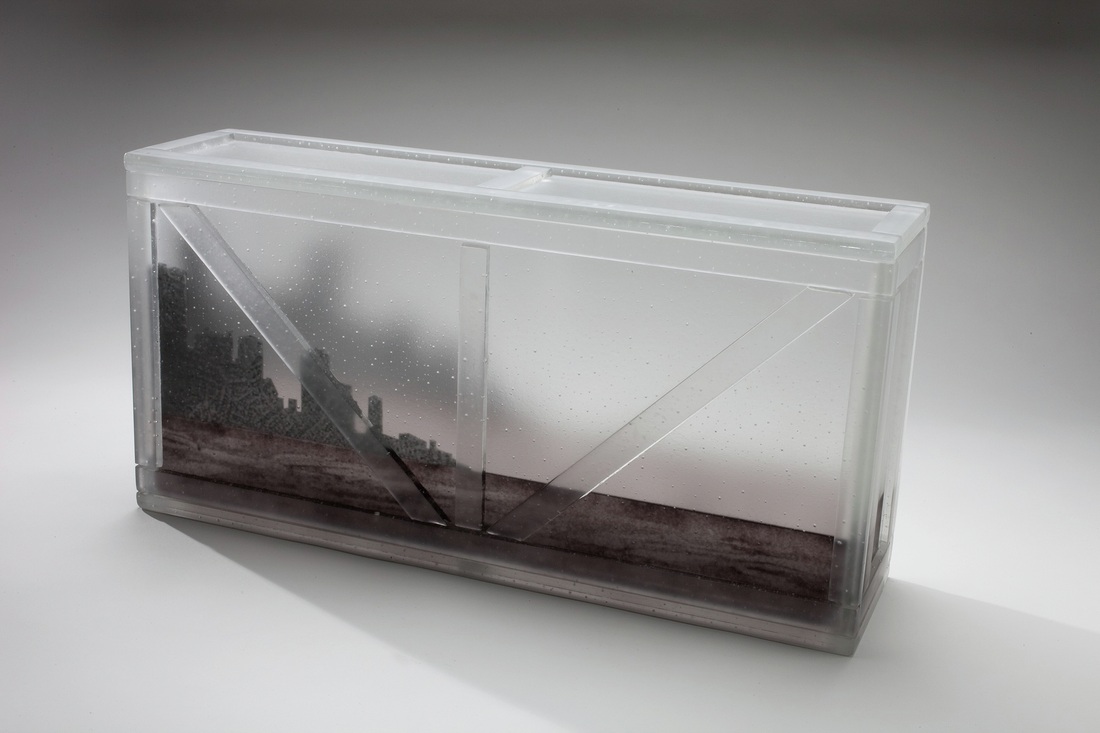
Lepisto grew up in the glass capital of America, Toledo, Ohio. This industrial setting has made a huge impact on his aesthetic. Looking at his body of work you can see hard architectural lines as well as iconic structure such as his water towers. These visual influences are only one part of the narrative which resonates from his childhood into his present day life.

The work ethic in the family was strong and Lepisto himself worked from an early age. He spoke fondly of his family and specially his Grandfather ‘Pops’. Lepisto tells of how his Grandfather took great pride in his work and believed “a firm foundation is the key to a successful structure”. This sentiment has left its mark and this can be seen not only in the care and quality of the art works Lepisto produces, but also in the images he showed of his immaculate workspaces.

Lepisto describes his work as self portraits, each one reflecting his current situation and how it relates to his present environment. In doing this he creates a body of work which encompasses both the banality and the complexity of life simultaneously.
This work, inspired by a sense of place and strong relationship with the visual experiences available in the United States, came up against a challenge when Lepisto and his wife made the decision to move to Australia. Away from his support network and the landscapes which appear as such an integral part of his early work Lepisto had to tackle his art from new angles.


The most recent series, the container series, looks at transition and how life in one location can be packaged and moved another location. The lack of imagery in this series stems from a concern about appropriation of Australian vernacular architecture. This landscape, not yet ingrained in Lepisto sense of self, perhaps in time will begin to creep into new work. The auto biographical element in the work is strong and Lepisto is very open about the events which inspired the works.


 In an earlier series building blocks the pieces can be moved to form double meanings. In one position the images build from the edges into a cityscape, arranged in their second configuration to buildings start at the edges of the work and fade into a blank space in the centre. Lepisto explained how this series was made in a period where he and his wife where living in different locations. He drew our attention to the position of two small post boxes in the imagery and the piece changed from a clever puzzle to an eloquent expression of the pain of being apart and the joys of being reunited.

Lepisto’s practice is visually very beautiful and would be pleasing as studies of environment alone. However, it is the ability to produce subtle meanings in the works which push them to a new level of significance.


For More Info on Jeremy's work click HERE


by Fiona Byrne