Friday, 3 May 2013

Boyd Sugiki & Lisa Zerkowitz: Lectures on personal practice

Apologies for the slow down on blog post in the last few weeks, I have been away in Scotland but am returning soon and will get lots of news and articles up ASAP! In the mean time you may like to get your glass fix at this talk at the National College of Art and Design:


Tuesday, 12 March 2013

Glassblowing in Stourbridge


The following article has been written by GSoI member Catherine Keenan. Catherine Keenan is a glass artist based on the lovely north coast of Ireland, in Portstewart.

Finding a glassblowing studio whose hiring rates are reasonably priced, with a skilled assistant on hand, if desired, and the studio is always up and running and available has proven difficult to find over the years.  Since 2009 I had travelled to Sunderland to hire at the National Glass Centre, but with their major renovations last summer I was forced to find a new venue.  So I took a chance on the ‘Stourbridge Glassblowing Studio’, at the Ruskin Glass Centre.  It is part run by my ‘old’ teacher from the International Glass Centre, Stephen Foster who shares it with Peter Fricker and brothers Ian and Vic Bamforth.


A major draw for me to hire their studio is the fact that Ian Bamforth assists me, therefore he knows all the workings of the space and as a skilled maker can offer helpful advice.  He’s also easy going and a good laugh...that always helps when under pressure due to the expense and time restraints of hiring!

Although you will need to bring your own hand tools, with a some prior communication, the studio has everything else you would need.  I would suggest to other irish makers who are flying over to order your glass colour so it is delivered directly to the studio. 

There is an introductory offer for your first day of hiring; £135 and subsequent days are 
£170 each.  It’s £80 per day for an assistant.


If you can spare some time to see the area there are several museums and quite a few studios to visit.  The Ruskin Glass Centre, which hosts the British Glass Festival and Biennale, has many glass artists based there and also the recently opened Webb Corbett Visitor Centre.  I was fortunate enough to be personally shown around the museum by former factory master glassblower Malcolm Andrews.  He also happened to teach at the International Glass Centre, Brierley Hill (before my time) and had very fond memories of a young Paedar Lamb!


Not far up the road (it’s called the ‘Crystal Mile’) is the Red House Glass Cone, which is the only fully intact example of the18th century red brick glass cones that used to be dotted all over the area.  There’s a museum display and glassblowing studio with live demos.  Then, just a bit further still, is Broadfield House Glass Museum which has a huge glass collection ranging from the 17th century to the present day.  You can also watch skilled glassblower Allister Malcolm at work.

If you like real ale I can’t imagine there’s a better place in England to sample a wide variety of great beer in real pubs...that’s another reason to enlist Ian as an assistant as he’s a wealth of knowledge on decent pubs!

It’s easy enough to get to Stourbridge from Birmingham airport, there is a train station at the terminal (connected by a monorail), you get the train to Birmingham New Street, then walk to Moore Street Station (5 mins) and get the train to Stourbridge Junction, and finally get a connecting train to Stourbridge Town.  You can get a taxi from there, or ask at the bus station for a stop by the Ruby Cantonese Chinese Restaurant which is beside the Ruskin Glass Centre.

If you have any questions feel free to contact me via email: catherinekeenan126@gmail.com


by Catherine Kennan


Friday, 8 March 2013

Karen Donnellan writes about Jeff Zimmer for GAS Newsletter


Jeff Zimmer’s background in acting retains a strong influence over his work. The series, Theatres of Glass (2010-2011) is an obvious offshoot, but even the newest works from the whitewash series feel like a scene, set for action. After completing a Bachelor of Arts in Theatre Studies, Zimmer realised the vulnerability inherent in acting in the rehearsal stage was too much for a lifetime’s pursuit. Conversely, creating an object separate from the artist allowed him to experiment with creative abandon in the privacy of his own studio. Thus began his career as a visual artist and maker.

The artist’s current series, whitewash, is decidedly political in content. In each of these beautiful snow-scapes, the debris and reminders of death are only partially hidden from view. It is an anti-war statement, but is made in a way that “those who supported the war can look at it and appreciate it.” Jeff employs a Taoist approach in the assertions he makes
within the work. Being very conscious of the growing polarization of politics and society in the US, his work is an empathetic communication of his ideals. While consciously making them as beautiful as possible, it allows for the ugly message to be put across in a more digestible way. In doing so, he hopes for the audience to appreciate the duality without judgment. In his own words, the work alludes to “the way in which we all try to whitewash something of ourselves, as individuals and as nations. It’s a human need to see oneself as someone who is good on some fundamental level, so that tension between the desire to present ourselves as good, is in conflict with the knowledge we have of the bad things we have done.” 


The key moment that redirected his creative energies towards painting in particular, came to pass at an exhibition of cubist art at the Montreal Museum of Fine Arts. Jeff describes this as “an incredible damascene moment where I suddenly started to see the world rendered in flat planes of three-dimensional stained glass. It was unlike anything I had seen in my life, but I knew then that I was going to work with flat glass.” Following several years of researching and solitary experimentation on the kitchen table with a 7” square kiln, Jeff came across a work by Judith Schaechter called Little Torcher at Renwick Gallery in DC. This pivotal discovery brought about some drastic technical and visual changes in Zimmer’s work and Schaechter later became a mentor.
 He also recognizes Tim Tate and Michael Janis of the Washington Glass School among those who inspired and supported him early on in his glass career. “Tim Tate was there at the beginning, being able to share a studio with him as he set up the Washington glass school opened so many doors, and the fact that he was so interested in taking glass and pushing it forward in terms of content was significant,” Zimmer says.
In 2004, Zimmer began working towards a Master’s to allow for a more focused and full-time exploration of the technique. His research of programs on both sides of the Atlantic lead him to the Edinburgh College of Art (now part of the University of Edinburgh). The program, then lead by Ray Flavell and Alec Galloway, was one of few that offered Architectural glass on a full time basis. It was here that his ideas on perception and ambiguity developed, which remain strong themes in his work to date. Upon graduation, he was offered a position as Artist in Residence, in addition to teaching architectural and stained glass to part-time students in conjunction with the college’s Office of Lifelong Learning Program. Jeff still runs the part-time stained glass course and is presently a Temporary Lecturer in Glass within the main Glass Department.

A residency at North Lands Creative
Glass in 2006 brought about another shift in artistic direction for Jeff. Having arrived in this remote landscape at the Northern tip of Scotland with a very cerebral proposal for new work, it proved difficult to resolve. However, he couldn’t help but respond to the 360-degree horizon he found there, which his first landscapes. The impetus of the series was in part, “to capture that elemental feeling of such vast space.” Previous to that opportunity, Jeff’s work had been strongly figurative, but as I found out, his military father painted landscapes as a hobby. Jeff’s work does stem from a very different emotional place, but even so, perhaps it is no surprise that he has been drawn to the genre.

Despite these references and the suggestive title, we were All wrong, the work retains an element of ambiguity. As for the frames, those are scoured from second-hand shops and auctions. The more ostentatious and grandiose, the better. As a classic marker of important and perhaps conservative art, Jeff conciously utilizes them to undermine the cosy nature that the patina of time gives to older art, implying a feeling of safety.
The notions of borders will be explored in Jeff’s next body of work, which is particularly relevant as the Scottish Independence Referendum is coming up in 2014. Where, as the artist notes, “We will have the whole country deciding how we define ourselves... Who is in? Who is out?”

Jeff is the editor of the Scottish Glass Society newsletter, which is published on
a quarterly basis. His work is represented by The wexler Gallery in Philadelphia and Maurine Littleton Gallery in washington, DC 
a quarterly basis. 


Jeff Zimmer will be teaching a glass painting workshop at the National Sculpture Factory this April, for more info see the NSF website: HERE 


This article was first published in GAS News, January 2013

The GSoI would like to thank  the GAS for allowing the reproduction of the above article for our blog
By Karen Donnellan


Sunday, 10 February 2013

Jeremy Lepisto at the National College of Art and Design


The Glass Society of Ireland was delighted to attend Jeremy Lepisto’s talk at the National College of Art and Design on Tuesday. He is very open about his work both conceptually and technically which made for a fascinating talk.


Lepisto grew up in the glass capital of America, Toledo, Ohio. This industrial setting has made a huge impact on his aesthetic. Looking at his body of work you can see hard architectural lines as well as iconic structure such as his water towers. These visual influences are only one part of the narrative which resonates from his childhood into his present day life.

The work ethic in the family was strong and Lepisto himself worked from an early age. He spoke fondly of his family and specially his Grandfather ‘Pops’. Lepisto tells of how his Grandfather took great pride in his work and believed “a firm foundation is the key to a successful structure”. This sentiment has left its mark and this can be seen not only in the care and quality of the art works Lepisto produces, but also in the images he showed of his immaculate workspaces.

Lepisto describes his work as self portraits, each one reflecting his current situation and how it relates to his present environment. In doing this he creates a body of work which encompasses both the banality and the complexity of life simultaneously.
This work, inspired by a sense of place and strong relationship with the visual experiences available in the United States, came up against a challenge when Lepisto and his wife made the decision to move to Australia. Away from his support network and the landscapes which appear as such an integral part of his early work Lepisto had to tackle his art from new angles.


The most recent series, the container series, looks at transition and how life in one location can be packaged and moved another location. The lack of imagery in this series stems from a concern about appropriation of Australian vernacular architecture. This landscape, not yet ingrained in Lepisto sense of self, perhaps in time will begin to creep into new work. The auto biographical element in the work is strong and Lepisto is very open about the events which inspired the works.


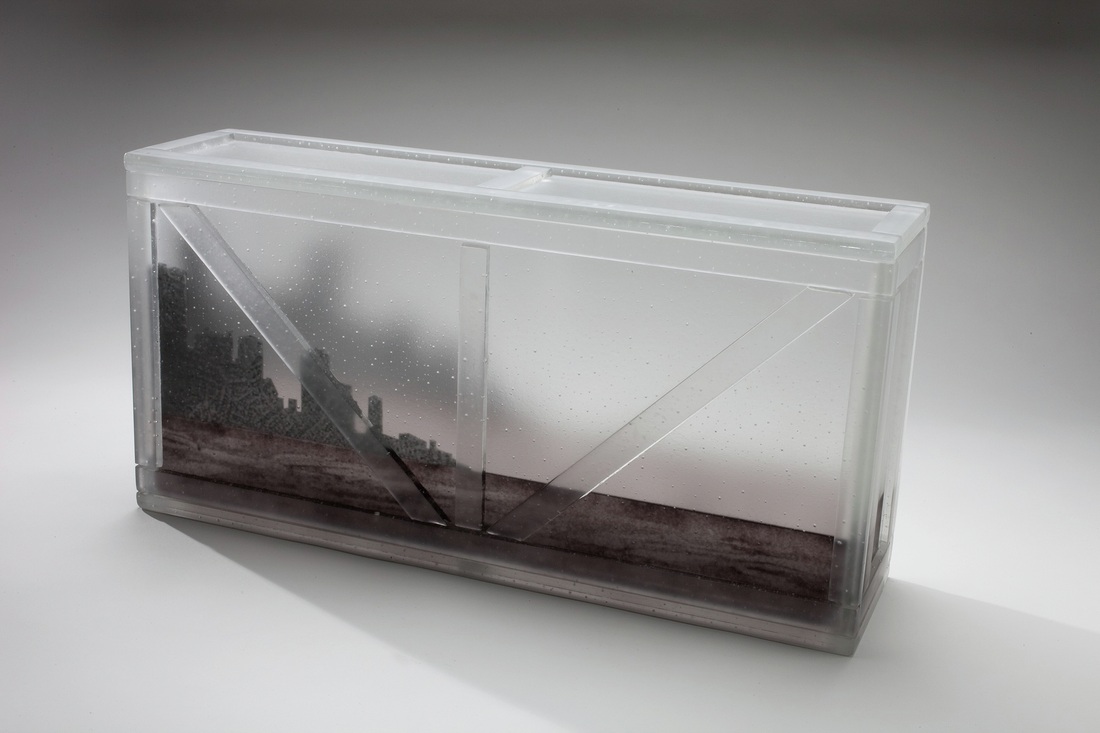
 In an earlier series building blocks the pieces can be moved to form double meanings. In one position the images build from the edges into a cityscape, arranged in their second configuration to buildings start at the edges of the work and fade into a blank space in the centre. Lepisto explained how this series was made in a period where he and his wife where living in different locations. He drew our attention to the position of two small post boxes in the imagery and the piece changed from a clever puzzle to an eloquent expression of the pain of being apart and the joys of being reunited.

Lepisto’s practice is visually very beautiful and would be pleasing as studies of environment alone. However, it is the ability to produce subtle meanings in the works which push them to a new level of significance.


For More Info on Jeremy's work click HERE


by Fiona Byrne

Friday, 1 February 2013

Charlene McFarland: Eedi & Éabha


Eedi & Éabha is a series of investigative events taking place in Tallinn, Estonia in February 2013. The project develops a partnership between Ireland and Estonia through exhibition, panel discussion and workshop.

A solo exhibition of the work of Northern Irish sculptural artist Charlene McFarland at GaleriiPINK will be the principal event of Eedi & Éabha. Heavily influenced by motor engineering, her pieces combine authentic recycled car components with blown glass and metal, and are imbued with a rhythmical energy informed by her experiences in car restoration workshops and showrooms. The work possesses a sense of animated vigour, reinforced by the fact that the changeable objects of each work are connected by magnets. This exhibition is curated by Emer Lynch.

The Estonian Academy of Arts will also host a panel discussion considering the international presentation of European applied art and the future of the field for emerging artists. Speakers for this event include curator Emer Lynch (IE), art critic Heili Sõrmus (EE), educator/ glass artist Tiina Sarapu (EE), marketing consultant Heidi Ruiso (EE) and textile artist/ designer Monika Järg (EE). This event is free and presentations will be in English.

The title Eedi & Éabha is derived from the names of the participating countries: Eesti & Éire. Taking inspiration from Charlene McFarland’s custom of naming her works after characters related to her research, Eedi & Éabha are identities embodying the personality of each country. Teamed together, the pair upholds an awareness of language, national identity and the building of European relationships.


Exhibition:
31st January – 25th February | Opening: 30th January at 6pm
GaleriiPINK, Telliskivi 22, 10611 Tallinn
Opening hours: Wed – Sun: 11am – 6pm

Discussion:
1st February 2013 at 4pm
Estonian Academy of Art, Estonia pst 7, room 245

Workshop by Charlene McFarland and Emer Lynch: Collection/ ConstructionThursday 31st January & Monday 4th February 2013
Estonian Academy of Arts, available to students of the Academy


Eedi & Éabha is supported by Culture Ireland as part of Ireland’s EU Presidency Culture Programme 2013.
www.facebook.com/Eedi.Eabha
www.facebook.com/GaleriiPINK

Wednesday, 30 January 2013

Showcase 2013

Recently I got the opportunity to visit Showcase at the RDS and talk to some of the makers there. Here is a quick summary of the glass that was on display this year:


Louise Rice
Rice Glass

Rice is based at the Leitrim Sculpture Centre. She is known best for her sculptural work which consists of life like mould-blown forms often combining found objects. Rice’s work at Showcase is a new range of wall art which uses bullseye glass and powdered enamels to depict natural flora. The work is elegant and well presented with an affordable price point. This series is sure to be a hit.


Jerpoint Glass Studio

Jerpoint glass is a family run glass studio based in Killkenny making quality home wear products. The studio and gallery are open all year round to visitors and you can watch skilled glass blowers at their trade. At showcase this year Jerpoint brought a selection of their production range which is full of multiple colours. They have also just released a new range called Cherry Blossom with is a soft pale pink and uses optic moulds for a delicate, vintage feel; a great product for Valentine’s Day and springtime.


Jonathon Ball
Glass and Metal Artist

Trained as a blacksmith Ball studied glass blowing at Edinburgh college of art. He is now based at the Leitrim Sculpture Factory. Ball combines his knowledge of blacksmithing with his glass skills to create bespoke pieces of sculpture. The pieces on display at Showcase this week include a triptych of large glass anvils. The sides of these pieces are left with an opaque finish and the tops polished to a transparent window through which one can peer inside. The large glass and metal sculpture uses blown pieces of glass and is a striking feature as one walks up the stairs to the top level of the building.


The Irish Handmade Glass Company

The Irish Handmade Glass Company was set up in Waterford after the closure of the Waterford Crystal Factory in 2009. They have a passion for continuing the tradition of glass blowing in the area and all the work is handmade at the studio. Their work at showcase was highly colourful, the most memorable pieces being their large spun glass plates. They are also releasing a special Emblems of Ireland range for the 2013 Gathering.


Terence MacSweeney

Kerry Crafted Glass

Kerry Crafted Glass is based in Killarney and is also open to visitors, they offer free glass blowing demos but to avoid disappointment you should contact them in advance of your trip. Their work uses an earthy colour pallet to create functional home wear such as vases, plates and candle sticks. Their glass lamps use coloured firts to create soft coloured shadows in a room. As well as their blown work they have some fused pieces, a range of glass mirrors. 


  by Fiona Byrne

Wednesday, 23 January 2013

Dr Vanessa Cutler at the National College of Art and Design


Dr. Vanessa Cutler recently visited the National College of Art and Design in Dublin to speak about her recently published book ‘New Technologies in Glass’. The Glass Society of Ireland was invited to attend and we also got the chance to have a few words with Cutler after the talk.

Cutler’s dedication to her chosen medium and technique is clear. Utilising the technique of
waterjet cutting in her sculpture, she pushes the limits of glass and stretches the technology to its boundaries. She challenges herself and those she mentors and collaborates with to look at things inside out and upside down, she turns our perceptions of craft, design and the applied arts on its head.

Although Cutler does not define herself as an engineer, she shares an engineer’s mentality in striving to achieve a specific desired outcome, whilst as an artist she finds freedom in sometimes allowing the equipment to dictate the final aesthetic of the work. She fully acknowledges the tension that exists in her work between art and engineering. This is not surprising when you hear of her father’s influence in her life, himself an engineer, from whom she developed an early interest in the workings of the world around her. It seems natural then that her interest in glass would meet her love of technology and waterjet manufacturing has allowed this to happen for her.

Taking risks with glass is a huge part of Cutler’s practice: seeing how close to the edge she can cut, how close together can the cuts be? This constant pushing of the process and material has resulted in some innovative pieces of glass (although she laughs about the resulting transportation issues). “Don’t stay within the compounds of what you know” is Cutler’s motto. True to her word, she has spent the last decade finding answers to questions, often with triumphant and unexpected results. This is seen in her series Fingertips, which proved that blown glass can successfully be cut by waterjet.

When asked about her influences Cutler noted the great respect she holds for other contemporary makers she has collaborated with. Stemming from the beginnings of her career in stained glass, architecture is a key stimulus to the development of her work. Her pieces employ simplicity in their aesthetic. She deals with composition with a minimalist approach, often repeating a shape within a formal arrangement which tests her technical knowledge to the limit.

Her pieces are also sparked from a sense of place and memory. She rarely takes photographs of her travels but uses the impressions of the places retained in her visual memory to inform her practice. Shapes stay with her, sometimes for years after a visit, until they find their way into an artwork. In this way, she believes that, “glass can say more about you than you can say yourself”.


For more information on Cutler and her work visit her webpage HERE

To purchase her book 'New Technologies in Glass' CLICK HERE


(by Fiona Byrne & Emer Lynch)

Thursday, 3 January 2013

New Year - New Team

We hope that all out members had a wonderful 2012 and we would would like to take this opportunity to thank you for all your support throughout the year. We hope that 2013 will be a great year for glass!
We have recently had a change of staff and would like to introduce you to the new team:


CHAIR PERSON: Debbie DawsonDebbie has been working in stained glass for over 20 years. Her work is held in both public and private collections. She is passionate about glass and has worked as a curator and an educator. We are delighted to have her as our new chair for 2013.http://www.debbiedawsonstainedglass.com/


VICE CHAIR: Deirdre RogersDeirdre has worked with both Cavan Crystal and Waterford Crystal while building up a wide and varied portfolio. She set up her own contemporary glass studio in 1996 under the name Various Vessels. She now works under her own name and has received many awards for her work and has exhibited throughout Ireland and abroad.http://www.deirdrerogers.com/


TREASURER: Gerlinde KuglerGerlinde is located in the Garden of Ireland in Co. Wicklow. She is a glass artist whos work incorporates colour, light, texture and where possible smell and sound. As well as making her own work she runs a series of workshops sharing her skills with others.http://www.gerlinde.ie 


EDUCATION OFFICER: Dr. Caroline MaddenDr. Caroline Madden is an educator/artist who teaches at the National College of Art and Design and serves on the Executive Committee of the Glass Art Society.  Madden received a PhD in Educational Leadership from Barry University, Florida (2010); an MFA in 3D Sculpture from Massachusetts College of Art, Boston (1992) and a BA (Hons.) in 3D Design from Stourbridge College of Technology (1987). She was Professor of Art at Jacksonville University (1992-2007) where she co-founded and directed the Glass Institute of the Southeast (1997-2000); directed the Governors High School Summer Program for Gifted and High Achieving Students (2001, 2003); mentored students presenting at the annual  National Conference for Undergraduate Research.  Madden has work in the collections of the National Museum of Ireland, the Ulster Museum, Belfast, and completed public works Lyrical Lighthttp://www.glassart.org/CarolineMadden.htmlhttp://www.culturalcouncil.org/gallery/lyrical-light


EDUCATION OFFICER: Emma BourkeEmma graduated with Honours from the National College of Art and Design in Dublin and where she learned the techniques of glassblowing and hot sculpting. Self-taught in the technique of flameworking, she was able to translate these previously acquired skills to create work on the torch. Through extensive research and through trial and error she has taught herself how to create intricate flameworked flowers such as snow drops and daisies. The transparency of clear glass is intentionally maintained in order to heighten the ambiguity of an organic ecosystem. Adding a little colour to some petals allows each piece to become characteristically unique like the environment which inspires its conception.http://www.emmabourke.com/


MEDIA AND COMMUNICATIONS OFFICER: Fiona ByrneFiona studied Glass and Visual Culture at the National College of Art and Design in Dublin. She then went to work for the development director at the Scottish Sculpture Workshop in Lumsden. Following this she worked as a studio assistant at Glasstorm Contemporary Glass Studio in Tain, Scotland. During her time in Scotland she was awarded a Talent Scotland graduate placement, Friends of Northlands Funding to partake in a NCG master class in surface treatments and Contemporary Glass Society funding to attend the NCG conference. She has her own glass jewellery range called fifi loves jewellery. Currently she is studying for a MA in Arts Management and Cultural Policy at UCD.http://www.risecreatives.com/fionabyrne/index.aspxhttp://www.facebook.com/pages/Fi-Fi-Loves-Jewellery/105337326212813

   DEVELOPMENT OFFICER: Emer LynchEmer Lynch graduated with Honours in Glass and History of Art and Design from the National College of and is currently a Masters in Visual Arts Practices candidate at the Institute of Art, Design & Technology in Dun Laoighre. She completed an International Student Exchange Programme at Southern Illinois University Carbondale in 2008. Lynch was awarded a prestigious Leonardo Programme Placement at Derix Glas Studios, Germany, in 2009, was Artist in Residence at the University of Sunderland in 2011 and is currently Artist in Residence at NCAD.http://www.facebook.com/Emer.Lynch.Glasshttp://www.youtube.com/watch?v=sfggRjI4xpA
   

DEVELOPMENT OFFICER: Anike Tyrrell Anike is CEO of Waterford County Enterprise Board and her work involves daily commitment to both enterprise development and creating a positiveenvironment for the creation of new business in the region.  As such she has been actively championing the revitalization of the glass making industry in the area with a number of strong projects on the go.  With just a few makers still active in the industry and the last blower of crystal glass operating on a part time basis, great focus is required both from Government agencies and local interests to ensure this extraordinary heritage is not lost.http://www.enterpriseboard.ie/aboutus.shtml


   STUDENT REP DUBLIN:Meadhbh McIlgorm is a final year glass student at NCAD. She likes glass and likes talking and think we should all talk more about glass! Also she deeply wishes more students of NCAD would embrace glass as a medium and is doing her up most to promote the material within the college. 


   STUDENT REP CORK:Róisín lives and works in Cork. She is in her third year of a Fine Art degree at the Crawford College. Her interest is in the development of artistic practice through sculpture with glass and mixed materials. Róisín enjoys classic rock and sci-fi novels in her spare time.www.roisinfoley.wordpress.com


Monday, 5 November 2012

The Glass Society of Ireland in association with the National College of Art and Design present:
An evening of lectures on Wednesday 7th November 2012
 

Andrea McKay

International Art Projects Adviser & Co-ordinator for Derix Glasstudios, Germany
(5:45pm)


Inline images 4

 Architectural art glass in public and ecclesiastical settings

Andrea McKay has been  working with Derix Glasstudios for over seven years. She is responsible for projects in the UK, Benelux and Scandinavia. Projects she has managed range from small-scale to large-scale public art. Andrea describes herself as the link between the artist and the studio.

Clifford Rainey

Professor of Fine Art and Chair of the Glass Program at California College of the Arts, USA
(6:30pm)


 Inline images 3

Clifford Rainey is an artist whose work has been exhibited internationally for thirty-five years. Born in Whitehead, Co. Antrim in 1948, he later received a Master of Arts from the Royal College of Art, London in 1973 and later lectured there for seven years. Principally a sculptor who employs cast glass and drawing as primary methodologies, his work is interdisciplinary, incorporating a wide spectrum of materials and processes.

Rainey is a passionate traveller and his work is full of references to the things he has seen and experienced. Celtic mythologies, classical Greek architecture, the blue of the Turkish Aegean, Globalization and the iconic American Coca-Cola bottle, the red of the African earth, the human figure combined with cultural diversity all intermingle to provide sculptural imagery charged with emotion.

Rainey’s work has been exhibited internationally including the Ulster Museum in Northern Ireland, The Victoria and Albert Museum in London, The Kunstmuseum in Dusseldorf, Germany, The Millennium Museum in Beijing, China, and the Museo de Arts Contemporaneo in Monterrey, Mexico. His work is in the permanent collections of numerous museums including: The Irish Museum of Modern Art, Dublin, Ireland, The DeYoung Museum, San Francisco, California, The Los Angeles County Museum of Art, The Museum of Art and Design, New York, The Fine Arts Museum of Boston, and The Montreal Museum of Fine Art, Canada. He is presently a Professor of Fine Art and Chair of the Glass Program at The California College of the Arts. He is a recipient of the Virginia A. Groot Foundation Award, Chicago, and the 2009 UrbanGlass Outstanding Achievement Award, New York.

Wednesday, 10 October 2012

JERPOINT GLASS FEATURED IN LONDON DESIGN FESTIVAL 2012 VIDEO

A Place To Gather is a 5 minute film about Irish craft created by emerging Dublin based film producers Jamie & Keith, which was launched during London Design Festival 2012. A Place to Gather is about an approach and craft’s relationship to a wider culture. It is about a maker, a practical person in an often bewildering world. It is about a person; rooted and aware, drenched in the weather and materials of the land, part of a community, local and global, hedgerows and cables, influenced from inside and out, time’s power being respected and the materials’ better nature drawn forth. It is about a holistic way of thinking, an approach that creates objects of use - be that practical, emotional or intellectual. Objects that hold the tactility of their construction and through their use add value.

The video features Horizon Furniture, Studio Donegal, Basketbarn, Jerpoint Glass and Derek Wilson Ceramics.

W: http://www.aplacetogather.ie/